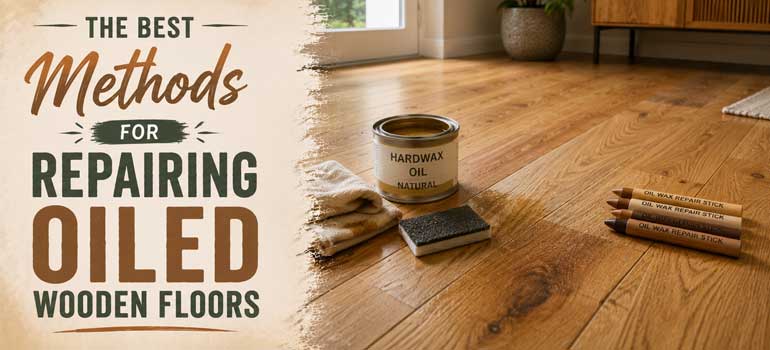
Oil-finished wood floors have a real practical advantage over other finish types when it comes to repairs: because oil soaks into the wood rather than sitting on top as a film, minor wear tends to blend into the surrounding surface rather than standing out sharply. That makes oiled floors easier to keep looking good over the years, and many repairs are realistic to handle without a professional at all.
Why oiled finishes hide wear better than glossy ones
Oil finishes enhance the wood's natural colour, grain and texture while soaking into the surface rather than forming a hard film on top. This is part of why oiled floors tend to show less visible distress over time than a high-gloss finish, where every fine scratch and scuff catches the light and stands out clearly. An oiled floor develops character gradually rather than looking patchy or uneven as wear accumulates.
What you can realistically repair yourself
Even without prior experience, a few common issues on an oiled floor are manageable as DIY repairs:
- Recoating with matching oil refreshes the whole floor's appearance and doesn't require sanding beforehand, one of the biggest practical advantages of an oiled finish
- Filler for deeper marks evens out more noticeable dents or gouges before recoating, giving a smooth surface for the fresh oil to sit on
- Spot treatment for an isolated worn patch, since oil finishes allow localised touch-ups that blend in far more easily than trying to patch a lacquered surface
Building a repair-friendly maintenance routine
Prevention matters as much as repair, and a few consistent habits reduce how often repairs are needed in the first place:
| Habit | Why it helps |
|---|---|
| Avoid dragging furniture | Prevents deep scratches that go beyond what recoating alone can fix |
| Clean regularly with a pH-neutral, wood-specific product | Keeps grit from grinding into the oil finish over time |
| Wipe up spills immediately | Prevents staining before it has a chance to set into the wood |
| Use rugs and mats in high-traffic areas | Reduces concentrated wear in the spots that see the most footfall |
| Go shoe-free where practical | Cuts down on the grit that causes most fine scratching |
Matching the cleaning product to the finish matters here too, an oil finish needs a product formulated for it rather than a generic wood cleaner, since the wrong product can strip or dull the oil rather than maintaining it.
When simple recoating is enough
For most everyday wear, fine scratches, general dulling, minor scuffs, a straightforward recoat with matching oil is usually all that's needed. This is one of the clearest practical benefits of choosing an oiled finish in the first place: refreshing the floor's appearance doesn't require hiring a sanding professional or taking the room out of use for days, a recoat can often be done relatively quickly and with minimal disruption.
When it's time to call in a professional
Filler handles moderate damage well, but there's a point where DIY repair isn't enough. Deep gouges, extensive staining that's penetrated the wood, or damage spread across a large area of the floor are all situations where wood floor sanding and refinishing becomes the more realistic option. Attempting to fix serious damage with filler and recoating alone tends to give a patchy, uneven result that a full sand would have avoided from the start.
If your oiled floor needs more than a simple recoat, or you're not sure whether your damage is DIY-manageable, get in touch and request a free quote and we'll give you an honest assessment.
Frequently asked questions
Do I need to sand an oiled floor before recoating it? No, this is one of the main advantages of an oiled finish, recoating can generally be done directly over the existing oil without needing to sand the floor first.
How often should an oiled floor be recoated? This depends on foot traffic, but many oiled floors benefit from a light recoat roughly once a year, with spot treatment as needed in between for specific worn areas.
Can I use any wood cleaner on an oiled floor? No, oiled floors need a cleaner specifically formulated for oil finishes. Products designed for lacquered floors can strip or dull the oil rather than maintaining it properly.
How do I know if damage is too serious for DIY filler repair? If the damage is deep, covers a large area, or has clearly penetrated beyond the surface finish into the wood itself, it's worth a professional assessment rather than attempting a DIY fix.
Does an oiled finish really show less wear than a glossy one? Yes, because oil soaks into the wood rather than sitting as a reflective film on top, minor scratches and scuffs tend to blend into the surface rather than catching the light and standing out.